
AppDeploy vs Lovable: AI Chat Deploy vs App Builder
We tested both on two real apps - a simple game and a full-stack expense splitter
TL;DR
- AppDeploy - free to use, deploy directly from your AI chat. Tell Claude what to build and get a live URL, without leaving the conversation.
- Lovable - subscription-based AI app builder. You leave the chat, open their editor, and build from there.
- Results - we tested both on two real apps. AppDeploy produced better results in this test, faster, and without iterations. Lovable struggled with the more complex app and could not get it working within our time budget.
Results at a glance
| Dimension | AppDeploy | Lovable |
|---|---|---|
| Tic-tac-toe (simple) | Working app, first try - polished UI, no iterations | Working app after iterations - UI bugs on first deploy, exhausted free tokens |
| Expense splitter (full-stack) | Working app in 4 minutes - login, database, currency conversion, all functional | Did not produce a working app - failed after several iterations (in this test, within 15 minutes) |
| Workflow | Stay inside the AI chat, prompt to live URL | Leave the chat, open a separate editor |
| Pricing | Free (requires a Claude Pro or ChatGPT Plus account) | Subscription-based, free tier with limited tokens |
Key takeaway: In this head-to-head test, AppDeploy produced working apps faster and with fewer iterations, directly from the AI chat. Lovable has strengths as a standalone builder, but the chat-native workflow gave AppDeploy an edge for prompt-to-production speed.
Related comparisons
These are fundamentally different tools
We decided to do a head-to-head match between the two platforms, although they are inherently different.
AppDeploy is not a hosting platform, not an IDE, and not a no-code builder. It is designed for chat-first workflows where the AI writes the code and AppDeploy deploys it. You stay inside the conversation the entire time.
Lovable is an AI-powered full-stack app builder. You leave the chat, open their browser-based editor, describe what you want, and Lovable generates and hosts the app. Lovable positions itself as “your superhuman full stack engineer” and targets founders, designers, and product managers who want to build apps without deep coding skills.
We gave both the same prompts and compared the results.
For background on what “chat-native deployment” means and how AppDeploy fits into that model, see What is chat-native deployment and How AppDeploy works.
Test 1: Two-player tic-tac-toe
We started with a small app that we thought would fly with no issues.
- On Lovable we opened a free account, although we had our credit card ready since we did not expect the free tier to take us very far.
- AppDeploy is free to use and works directly inside Claude (requires a Claude Pro account).
The prompt
I want a 2-player online tic-tac-toe game with an invite link mechanism
so you can share a link with a friend to join. Make it mobile friendly.
Make the UI fun and cheerful.
Results
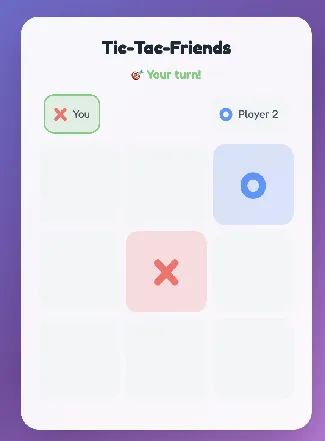
Both platforms got an app up and running. AppDeploy did it faster and in a single iteration, while Lovable deployed a non-usable app at first. After some iterations and UI fixes we got a working app from Lovable, but also exhausted our free tokens.
We were surprised by some UI bugs in Lovable’s output - layout issues we have encountered ourselves in earlier versions of AppDeploy and have since fixed.
Claude also came up with a good name (“Tic Tac Friends”) and the deployed app’s UI worked without any iterations and looks more playful.

And now to the real challenge.
Test 2: Trip expense splitter
The second app we tested is a trip expense splitter between friends, with login, backend (database, currency conversion), backups, and more. A really useful app, but not an easy one to get right.
The prompt
Trip expense splitter app for a group of friends traveling together.
Users sign in with Gmail - the first person to sign up becomes the admin
and can invite or approve other members. Each expense entry includes who
paid, what it was for (required), the amount, and which currency. The app
automatically converts everything to dollars using live exchange rates.
You can optionally select which friends shared each expense if it wasn't
split evenly among everyone. The app shows all expenses as cards with edit
and delete options (with confirmation), and displays a summary at the
bottom showing who owes whom with the minimum number of transfers needed
to settle up. Additional features: download all data as a backup file,
reset everything to start fresh, and upload a custom background photo
from your gallery.
Results
In this test, there was a clear winner.
AppDeploy produced a working app on the first try. Lovable could not produce a working app after several iterations, and we eventually gave up. We are confident we could have gotten Lovable’s app to work with more time, but for the sake of this experiment we decided not to invest longer - we were already 15 minutes in.
Time to live app - AppDeploy had a working app in 4 minutes. Lovable took 6:20 to produce its first version, which did not work.
Ease of use - With AppDeploy, we stayed inside the AI conversation. Claude generated the code and delivered a live URL. No publishing step, no leaving the chat. From prompt to live URL. Lovable had a Q&A phase and then got to work. We had to publish the app manually in order to test it.
Since a picture is worth a thousand words, here is a time-warped comparison of both platforms:
Lovable has its strengths - it asks clarifying questions upfront and surfaces QA automation in the UI (AppDeploy runs QA after every deployment too, but keeps it behind the scenes).
AppDeploy vs Lovable: practical comparison
| Dimension | AppDeploy | Lovable |
|---|---|---|
| Primary interface | AI chat (chat-first) | Separate browser-based editor |
| Deploy from chat | Designed for it | Not applicable - Lovable is a standalone platform |
| Full-stack defaults | Built-in primitives (DB, storage, auth, realtime, cron) | Supabase integration for backend, auth, and storage |
| Iteration model | AI generates and deploys in one step | AI generates, you review, publish manually |
| Pricing | Free (requires AI chat subscription) | Subscription-based with token limits |
| Best fit | Prompt-to-production apps built entirely in chat | Builders who want a dedicated visual app-building environment |
When to choose which
Choose AppDeploy if
- You want to stay inside the AI chat and get a live URL without context switching
- You want your app to work on the first try without unnecessary iterations
- You already have a ChatGPT Plus or Claude Pro subscription and want a free deployment layer on top of it
- You want to use the latest and most powerful models - AppDeploy works with whatever model your chat provides, while Lovable controls which model runs behind the scenes
Choose Lovable if
- You prefer a dedicated app-building environment with a visual editor
- You want built-in Q&A and clarifying questions before the AI starts building
- You are comfortable working outside the chat in a separate platform
FAQ
Is Lovable free?
Lovable offers a free tier with limited tokens. In our tic-tac-toe test, the free tokens were exhausted during iterations. Paid plans start at a monthly subscription. AppDeploy is free to use and requires a Claude Pro or ChatGPT Plus account for the underlying AI chat.
What is “chat-native deployment”?
Chat-native deployment is the ability to turn ideas described in an AI chat into a live app without leaving the chat or touching infrastructure. You describe the app in natural language, iterate in conversation, and the deployment happens automatically. For more detail, see How AppDeploy works.
Which tool produces better apps?
In this test, AppDeploy produced better results on both apps. The tic-tac-toe app worked on the first try with a polished UI. The expense splitter was fully functional in 4 minutes. Lovable struggled with the complex app. That said, results can vary by prompt complexity, and Lovable may perform differently on other types of projects.
Conclusion
These are different tools solving different problems. Lovable is an AI-powered app builder with its own editor and environment. AppDeploy is a deployment layer that works inside your existing AI chat.
In both tests we ran, AppDeploy produced a better result, faster, and without iterations. The tic-tac-toe app worked on the first try with a polished UI. The expense splitter - a real full-stack app with login, database, and currency conversion - was live in 4 minutes, while Lovable could not get it working within our time budget.
If you want to build and deploy directly from an AI conversation, AppDeploy is built for that workflow. If you prefer a dedicated visual builder outside the chat, Lovable is worth evaluating.